
Deposits & Withdrawals
How to Sell USDT Without P2P (2026): Direct Sell, Exchange or Off-Ramp
How to sell USDT without P2P: compare direct exchange Sell, a local bank-enabled exchange and a third-party off-ramp by availability, total cost and risk.
How to sell USDT without P2P: first check whether your exchange shows a direct non-P2P Sell method. If it does not, compare a legally available exchange with bank withdrawal against a reputable off-ramp. Choose by the final fiat amount, network compatibility and risk—not by a static fee table or another user's route.
Quick decision guide
| Your situation | Start here | Main thing to compare |
|---|---|---|
| USDT is already on an exchange and Sell shows a fiat payout | Direct Sell channel | Final fiat amount and payout method |
| Your current exchange has no bank route | Licensed exchange with local bank withdrawal | Network compatibility and total fees |
| USDT is in a self-custody wallet | Established third-party off-ramp | Supported network, provider identity and live quote |
| A stranger offers a private cash deal | Do not use it as a substitute | No reliable platform dispute path |
Route 1: use the exchange's direct Sell channel
On OKX, the official path begins at Buy crypto > Sell in Pro mode or Trade > Sell in Lite mode. After you select the asset and amount, the account displays the payment methods available to you. OKX says these may include P2P Express or third-party channels, but not every product is offered in every jurisdiction.
For a genuinely non-P2P route, choose only a displayed provider or payout method that does not create a user-to-user P2P order. Before confirming, check:
- the provider processing the sale;
- the supported fiat and receiving account;
- the exact amount you receive after fees and spread;
- the quoted payout time;
- identity-verification and cancellation requirements.
Do not infer availability from a marketing article or another user's screenshot. The live quote for your verified account is the contract that matters. See the official OKX Sell guide.
Convert is not a bank withdrawal
A common mistake is to use Convert and expect cash to arrive at a bank. OKX's official Convert FAQ says the feature swaps one crypto asset for another and does not convert crypto into fiat such as USD. A conversion can be an intermediate step—for example, changing into an asset accepted by a cash-out provider—but you still need a separate Sell or withdrawal route.
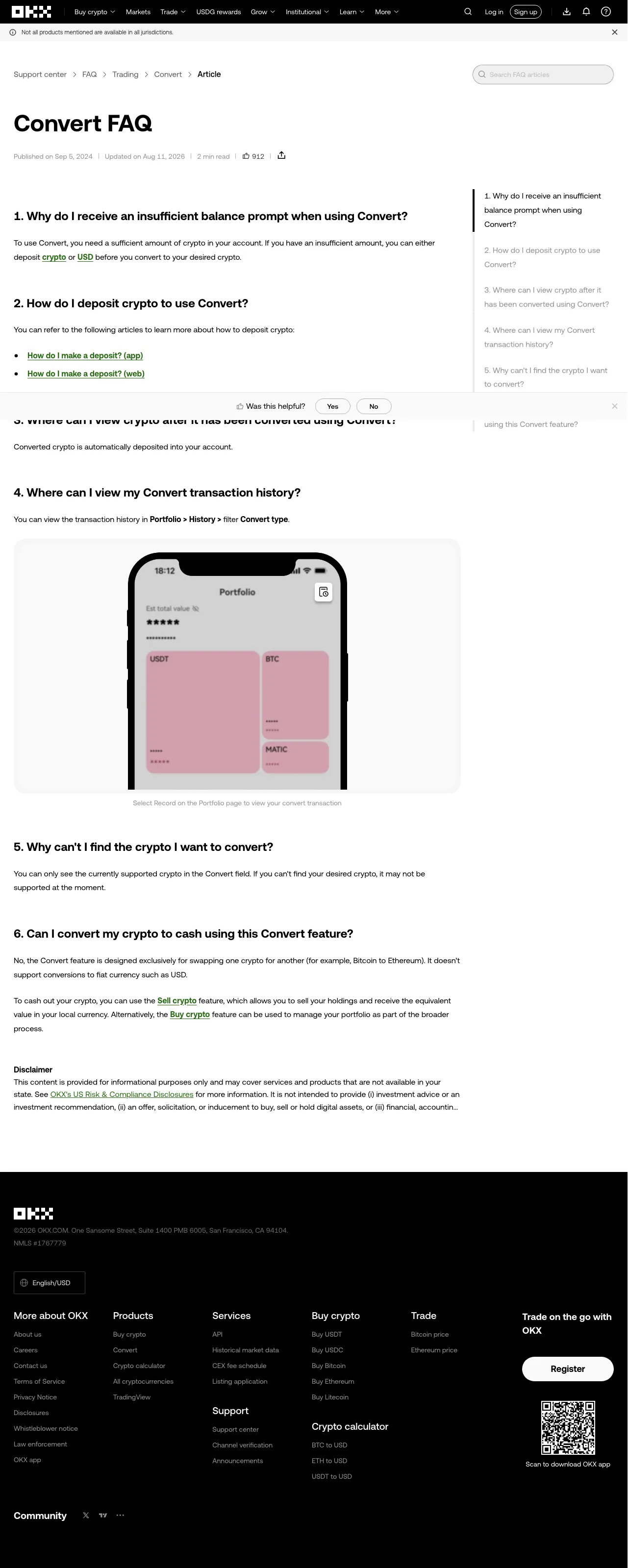
Real screenshot of the OKX Convert FAQ, checked on 2026-08-12. It distinguishes crypto-to-crypto Convert from the Sell feature used to cash out.
Route 2: transfer to an exchange with a bank rail
This route separates the job into three transactions: transfer the crypto, sell it on the receiving exchange, then withdraw fiat to your bank. It can be suitable when your current exchange does not support your currency but a legally available local exchange does.
Before transferring
- Confirm the receiving exchange supports deposits of the exact asset.
- Copy the deposit address from your own account.
- Match the network exactly on both platforms. “USDT” alone is not enough; the network must also match.
- Include a Memo or Tag when the deposit page requires one.
- Check the minimum deposit, confirmation requirement, current withdrawal fee, trading fee and bank-withdrawal fee.
- Confirm that the bank account must be in your name and that the platform supports your country.
Send a small test amount first. After it is credited, transfer the remaining amount, sell at the order type you understand and request the bank withdrawal. Save the withdrawal record and transaction ID.
Route 3: use a third-party off-ramp
An off-ramp provider accepts supported crypto and pays fiat through one of its available channels. This can be useful for self-custody wallets or countries where an exchange does not show a direct payout.
Provider coverage, networks, limits, fees and payout methods change frequently. Instead of relying on a static claim such as “fees start at X%” or “available in Y countries,” open the provider from an official integration or type its official address yourself, then obtain a live quote for your corridor.
Check these items before sending anything:
- the legal entity and official domain;
- whether USDT and your specific network are supported;
- the fiat currency and payout method;
- the final amount after every fee and spread;
- KYC requirements and transaction limits;
- refund handling if the transfer is delayed or unsupported.
Never send to a deposit address supplied through a direct message, social-media reply or search advertisement without verifying the domain independently.
How to compare total cost correctly
Do not compare only the visible service fee. Record the amount of USDT spent and the fiat amount that will reach your bank. Include:
- conversion or trading spread;
- explicit provider fee;
- blockchain withdrawal fee;
- receiving-platform trading fee;
- bank or card payout fee;
- foreign-exchange conversion, if the payout currency differs from your account.
For example, route A can advertise no service fee but deliver less fiat through a wider quote. Route B can show a small explicit fee yet provide a better final amount. Compare final outcomes at the same time and for the same amount because quotes move.
Region-specific questions
Can I sell USDT without P2P in India, Singapore or Malaysia?
Possibly, but a country name alone is not enough to confirm a route. Availability depends on the entity serving your verified account, local rules, asset, currency and the provider currently integrated. Check the live Sell screen and the prospective provider's official eligibility page. If the desired method is absent, do not use another person's account or falsify a region.
What if USDT is restricted on my chosen exchange?
Do not assume an old article's regional rules are still current. Check the exchange's current asset-status announcement for your account entity. If USDT cannot be sold there, choose a legally supported asset or route only after checking conversion cost, network support and tax consequences.
Safety checklist
- Complete KYC through the official provider before you urgently need the payout.
- Use a receiving account in the name accepted by the provider.
- Test a new route with a small amount.
- Keep the quote, sale confirmation, blockchain transaction ID and bank receipt.
- Stop if the domain, deposit network or payout beneficiary changes unexpectedly.
- Never accept a “no-KYC bank cash-out” offer from a stranger.
If you decide that P2P is still appropriate, read the P2P seller safety checklist before opening an order. If your funds are already on OKX, the OKX-to-bank route guide explains how to interpret the methods shown by your account.
Bottom line
To sell USDT without P2P, first check for a direct non-P2P Sell method on your exchange. If none appears, compare a licensed exchange with local bank withdrawal against a reputable third-party off-ramp. Verify the network, compare the final fiat received, test small and preserve records. That produces a safer answer than relying on fixed fee or country-coverage claims that may already be outdated.
Risk warning: Crypto transfers can be irreversible, and off-ramp availability is jurisdiction-specific. This guide is educational, not financial, tax or legal advice.