
Fees & Savings
APR vs APY in Binance and OKX Earn: How to Calculate Real Yield
APR is an annualized rate, not a guaranteed payout. Learn how APR, APY, tiered rates, fees and changing demand affect the return you actually receive from Earn products.
APR vs APY in Binance and OKX Earn: How to Calculate Real Yield
APR and APY are useful comparison labels, but neither is a promise that your account will receive the headline number. The product’s rules, balance tiers, borrowing demand, fees, lock-up period and changing rate all affect the result. Read the product page and its terms before depositing funds.
APR: the simple annualized rate
APR is a non-compounded annualized rate. A rough estimate is:
estimated return = principal × APR × time
For example, 1,000 USDT at a constant 5% APR for 30 days would be approximately 4.11 USDT before product-specific fees and changes: 1,000 × 0.05 × 30 / 365. It is an estimate, not a guarantee.
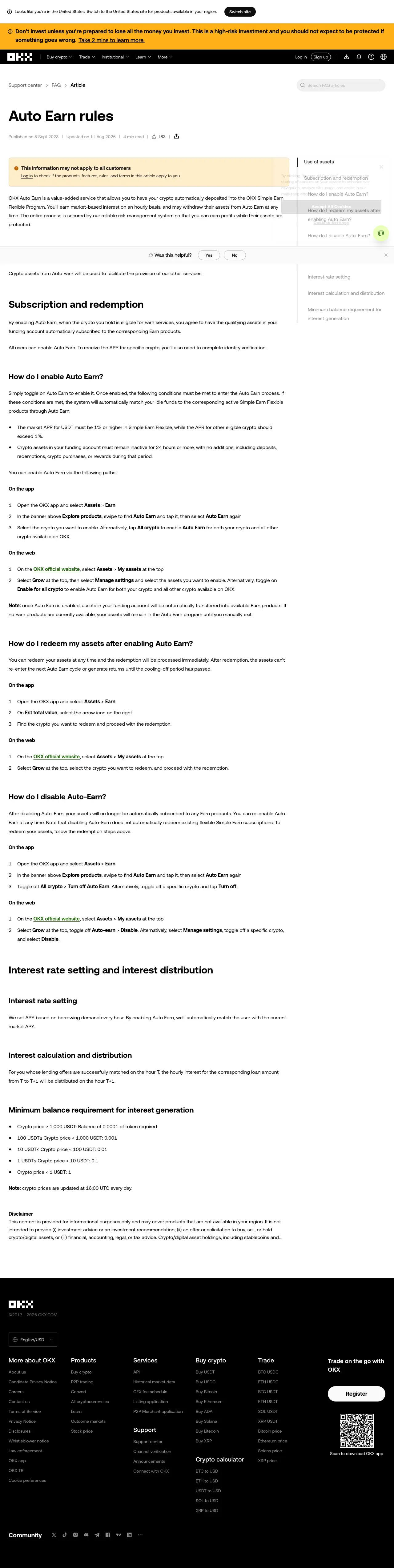
Some products calculate returns hourly or use lending demand to determine the effective rate. OKX’s Simple Earn Flexible FAQ gives a product-specific example where hourly return is based on lent amount × APR / 365 / 24 × 85%. That 85% factor is part of that product’s stated rule; it must not be applied to every Earn product or every platform.
APY: annualized return with compounding
APY assumes that earned rewards are reinvested according to a specified compounding schedule. A simplified formula is:
APY = (1 + APR / n)^n − 1
where n is the number of compounding periods per year. Real products may distribute hourly, daily, at maturity or under a different rule, so the displayed APY should be read together with the product’s calculation method.
Why the headline rate can be higher than your result
- Tiered rates: the highest rate may apply only to a limited balance band.
- Variable demand: lending or on-chain reward rates can change after subscription.
- Fees: a platform may retain a share of the gross return.
- Eligibility: KYC, region, asset and account requirements can limit access.
- Lock-up or redemption rules: you may not be able to withdraw immediately.
- Product risk: smart-contract, counterparty, liquidity and market risks can affect access or value.
A 10% banner on the first tier does not mean every dollar earns 10% for a full year. Calculate each balance tier separately, then subtract the stated fee or platform share.
A five-question product check
- Is the rate fixed or variable?
- Does the rate apply to the whole balance or only a tier?
- Is the displayed number APR, APY, estimated APR or a promotional rate?
- How are returns calculated, distributed and reduced by fees?
- Can you redeem immediately, and what risks could delay redemption or cause loss?
Record the rate, timestamp, asset amount and product rules when you subscribe. A later screenshot of a different rate is not proof that your original return was guaranteed.
Bottom line
Use APR for a simple annualized comparison and APY when compounding is explicitly defined. For a real estimate, follow the product’s own formula, tiers, fees and rate-change rules. The correct question is not "What is the biggest percentage shown?" but "What amount is eligible, for how long, under which calculation and risk conditions?"
Official references: OKX Simple Earn Flexible FAQ, OKX Auto Earn rules and OKX Earn overview.